From Behavioral Therapist to NeuroAffirming SLP
Something many people don’t know about me…is that I used to be a behavior therapist.
That may come as a surprise to some people, especially the people who know me well. Because what I do now is pretty much exactly the opposite of what I was trained to do as a behavior therapist.
But it feels like yesterday I was sitting next to 7-year old Olivia. She was in one of those blue plastic chairs with silver legs. A chestnut brown long rectangle table in front of us. We were both sitting on the same side.
Colorful crafts decorated the walls of the room and hung from the ceiling. On the floor next to us was a large classroom carpet full of every shape known to man.
And behind us sat a bunch of empty tables. The room we were using was essentially an abandoned classroom, and Olivia’s parents got the approval from the school to use it so that her private tutor could come in. This was a private school so her parents were able to work with the school to modify her schedule.
Across from us sat a retired special education teacher. A woman with short brown hair, brown eyes, and a radiant smile. She really loved working with Olivia.
The problem was that Olivia didn’t love working with her.
I sat next to her during all of her academic lessons with her teacher, from 8am to 12pm on Mondays, Wednesdays and Fridays.
And boy, was it torture.
If you think I meant it was torture for me, you’re right. But it was also torture for her. And that was the worst part.
I wished learning could be fun for her. But given the circumstances, why would it be?
Each lesson was a different set of flashcards.
When she would work on reading, she would place words in front of Olivia to read.

Rain + bow = rainbow
“Raiiiiinnnnboooooowww” - Olivia would stim for the next several minutes.
I used the compliance-based prompts I was taught to use by Olivia’s BCBA… “Quiet mouth” and “quiet hands.”
Ugh, I know.
I didn’t know much about behavior therapy then, and was just doing as I was told.
I also hardly knew anything about scripting or stimming. I think I’d heard the word “stimming” but that was pretty much the extent of my knowledge.
Looking back, the fact that I would be put in a position to work with an autistic child when I didn’t even know some of the most basic terminology, or characteristics of autism…um, how??
Sadly this is not uncommon. There are plenty of therapists who are hired as 1:1 age who have a very limited knowledge base of autism.
I didn’t know until several years later that everything I was instructed to do was likely causing harm. Even lifelong trauma.
The thing is - that even though I didn’t know much at that time. I did know one thing.
I knew it did not feel good.
That approach did not feel good to me. It did not feel good for her. And I think at the very least, when we’re searching for approaches to use with children, it should be something that feels good to all parties involved.
I learned the hard way that if something doesn’t feel good, it probably isn’t the right approach. And I’ve used that to guide my therapy over the years.
What I haven’t shared, is that after those 3 hour academic lessons, I’d go rogue.
As soon as Olivia had a break from doing work, we’d sit down on the spinning chair in the classroom. She’d sit on my lap and we’d sing. We used to take turns singing every other line of “You’ve Got a Friend in Me.”
She so genuinely enjoyed that time we spent together. And it truly felt like she was learning. I’d teach her new songs and she’d sing along with me. She’d be so happy in those moments. And I felt like I’d been forgiven.
And then when the bell rang, it felt like the clock struck midnight and Cinderella transformed back into her shabby clothes, the horses back into the mice, and the carriage into a pumpkin. It was time to go to the mainstream classroom.
Her day was designed so that we’d spend time with the other second graders every day after lunch. And that was arguably worse than the morning portion.
I think because the goal of being in that classroom was just that…being in that classroom.
The teacher would pass out the same assignment to Olivia that she would pass out to the other students. The other students would grab their pencil, put their head down, and start writing.
Olivia would swipe that paper off her desk so quickly that I had to put my hand down as soon as the paper hit the table.
I’d try to get her to participate and complete (at least part of) the activity…using my token board of course.
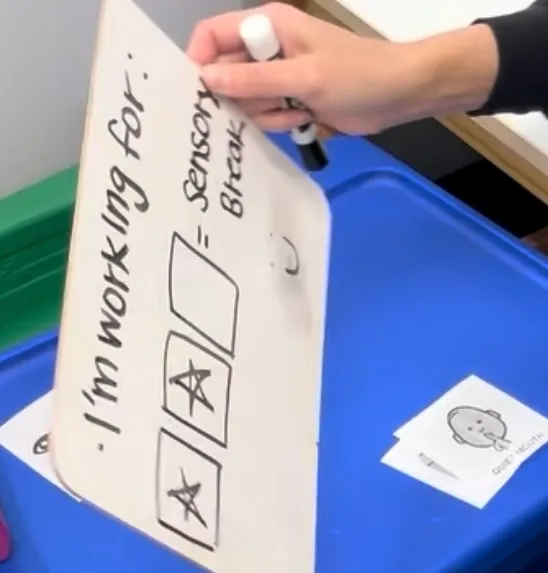
Eventually we’d get to a point where her behavior was so escalated that we had to leave the class. She’d flail her arms, yelp (for lack of a better word), and tip her chair back to the point of falling over.
And then when it came time for recess, I’d go rogue again.
We’d go down to the playground and she’d swing and swing. I’d sing all of her favorite songs and she’d sing along.
At the end of the school year, I told her parents that I wouldn’t be coming back. I was in graduate school at the time and the workload was increasing.
I realized then that I would never be happy in a job where I wasn’t able to use a play-based, connection-centered approach. I learned that if my core values as a therapist (and a human) were not in alignment with my work setting, it was going to be hard to feel fulfilled.
I learned a lot from that experience. If I could take it back, I would, because I hate that I used that approach with even one child.
But it’s clear I learned so much. And it really shaped the therapist I’ve become.
That experience was one of the first steps on a journey that completely changed the way I think about autism, communication, regulation, and connection.
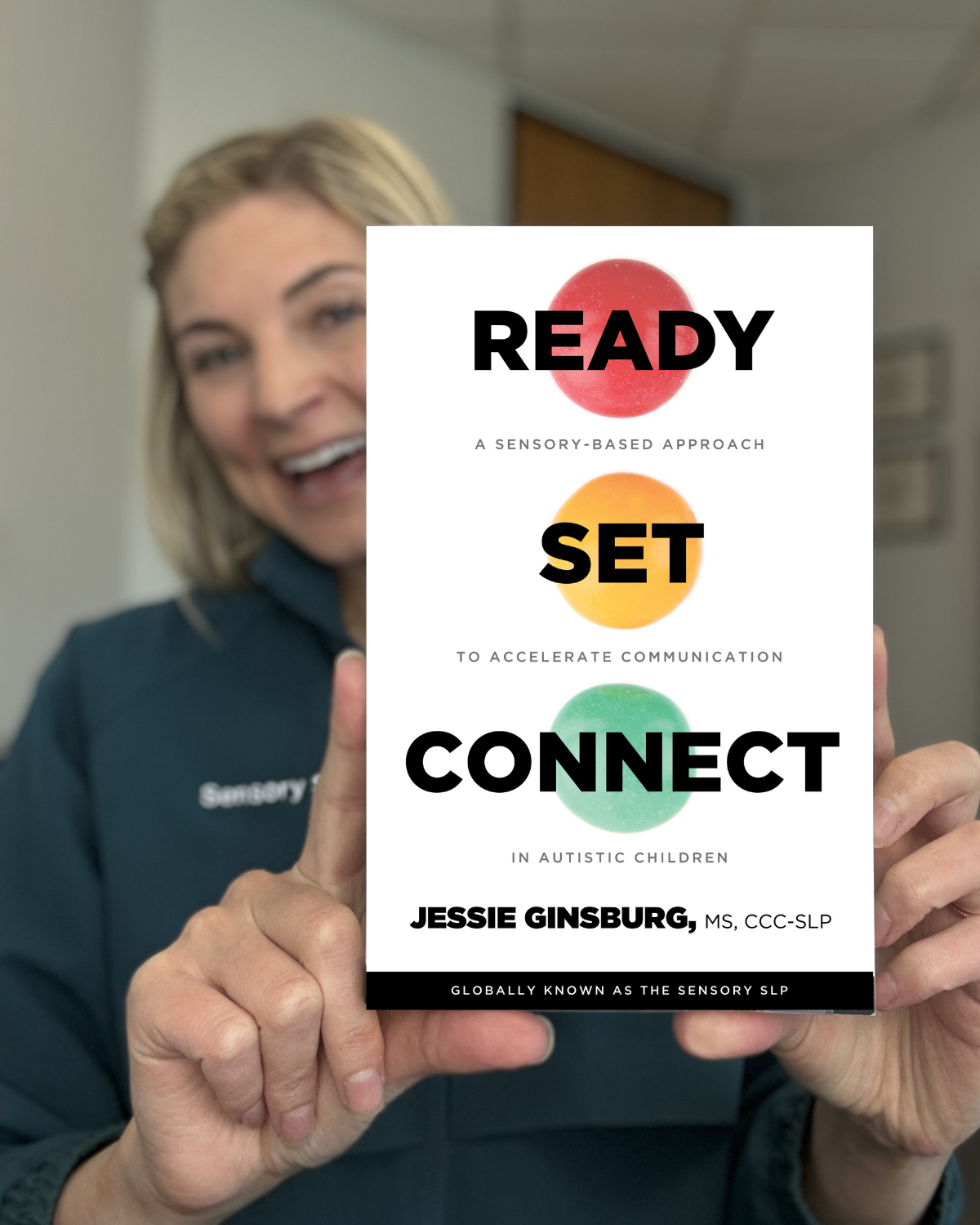
Many of the lessons I learned over the years (and the approach I wish I had known then) are the foundation of my book, Ready, Set, Connect.
If you’re looking for practical ways to support autistic children through connection instead of compliance, then I would love for you to check it out, or share it with someone who may need to learn more about building connection and communication.