
Understanding Gestalt Language Processing: Where It Started, What the Research Actually Says, and Why Context Matters
If you’ve felt confused, overwhelmed, or even a little frustrated by the way Gestalt Language Processing (GLP) is being talked about lately – you’re not alone.
I hear it from clinicians all the time.
Different definitions. Conflicting summaries. Strong opinions shared without much context. And a growing sense of, “I just want to understand what this actually means for the kids I support.”
So let’s slow this down.
Because Gestalt Language Processing didn’t start on social media. And it didn’t come from a single theory, framework, or moment in time. It comes from decades of research, clinical observation, and real children developing language in ways that didn’t fit a single-word-first model.
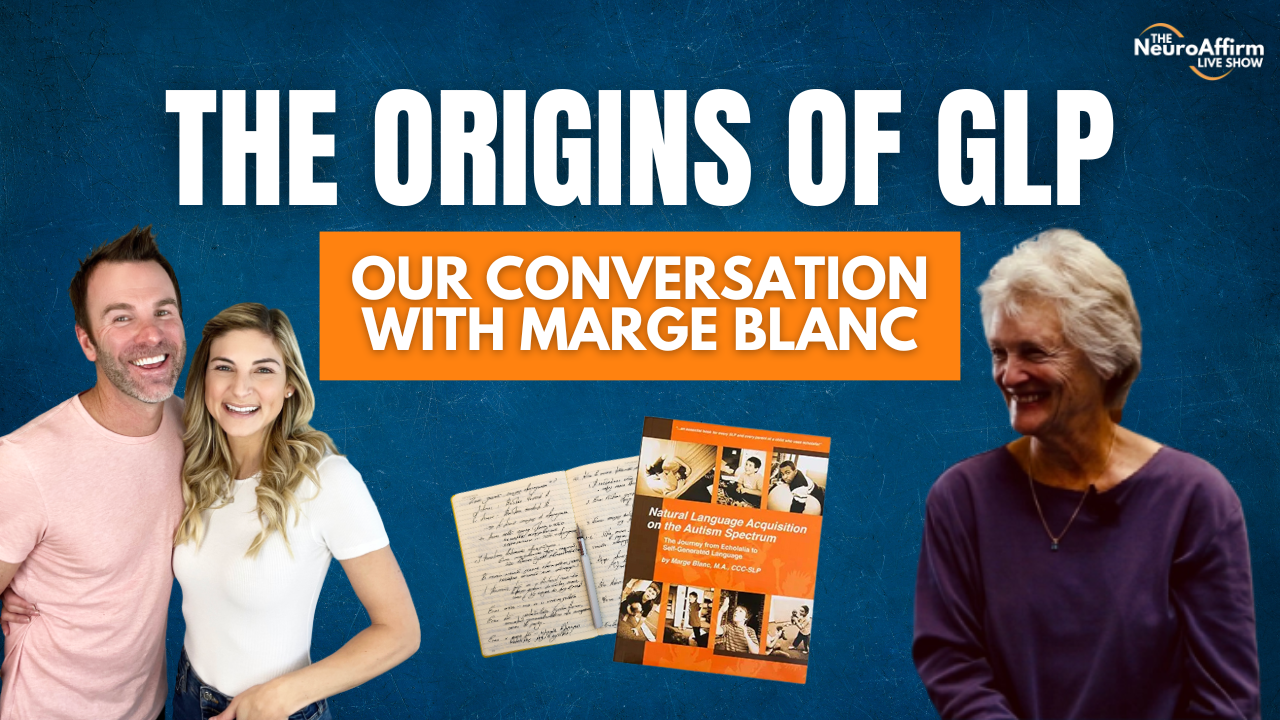
Recently, Chris and I had the opportunity to sit down and have a long, thoughtful conversation with Marge Blanc, the speech-language pathologist who coined the term Natural Language Acquisition (NLA) to describe the developmental process by which children move from echolalia to self-generated language.
That conversation reinforced something I’ve felt for a long time:
Much of the confusion we’re seeing right now doesn’t come from the research itself – it comes from missing history, missing context, and oversimplified summaries of deeply nuanced work.
So before we jump to conclusions or take sides, it’s worth grounding ourselves in where this work actually came from.
Let’s start with shared language
Before we can have a meaningful conversation, we need to agree on what we’re actually talking about.
Gestalt Language Processing (GLP) describes a way of processing language in larger chunks rather than individual words.
Analytic (or Generative) Processing (GP) describes language development that builds from single words into phrases and sentences.
Gestalt language development refers to the developmental pathway followed by many gestalt language processors.
Natural Language Acquisition (NLA) is the research-validated description of how gestalt language development unfolds – from echolalia to self-generated language.
These terms often get blurred together online. But when we collapse them into one idea, we lose important nuance – and that’s where confusion starts.
Gestalt processing is human, not new
One of the most important things to understand is this:
Gestalt processing is not unique to autism – and it’s not new.
Research on gestalt processing among humans has existed for decades and includes work by Jaime Hoerricks and others studying adult gestalt processors. From this perspective, gestalt processing is simply one way humans take in, organize, and make meaning of information.
This matters because it shifts the narrative away from deficit and toward variation.
How the conversation got tangled
GLP entered the field through two very different doors.
From a disability research perspective, gestalt language development was sometimes misunderstood or conflated with delayed or disordered language – and, in some cases, confused with Natural Language Acquisition itself.
At the same time, from a gestalt processing perspective, GLP was being discussed as part of a broader cognitive style seen across ages and abilities.
Without shared definitions, those perspectives collided. And once that happened, important distinctions were lost – especially in how this information was summarized and passed along.
The deep roots of gestalt language development
Gestalt language development has a long and well-documented research history.
From a linguistic standpoint, researchers like Ann Peters described how children often acquire language in chunks and later analyze those chunks into smaller units.
From a speech-language pathology perspective, Barry Prizant identified four stages of gestalt language acquisition based on careful clinical observation and research with autistic children.
These weren’t isolated ideas. Together, they described a developmental process – not a therapy method, not a trend, but a pathway.
How Natural Language Acquisition emerged
Natural Language Acquisition (NLA) developed as a research-validated framework describing how gestalt language development unfolds over time.
Longitudinal research expanded Prizant’s original four stages to include two additional stages focused on grammar development. This work took place over roughly 15 years and is documented in the addendum of Natural Language Acquisition on the Autism Spectrum by Marge Blanc.
And like all research, it had limitations:
- No children under age three
- No bilingual children
- Limited data on older clients
Naming those limitations doesn’t weaken the work – it strengthens how responsibly we apply it.
What we’ve learned since then
The research didn’t stop when the book was published.
Over the past decade, continued learning through study groups, conference presentations, and clinical collaboration has expanded our understanding of gestalt language development in real-world contexts.
Clinicians across the world have been contributing observations, questions, and refinements — helping us think more deeply about language, culture, AAC, and communication beyond spoken words.
Where this work is heading
Today, the conversation is growing – and it’s exciting.
We’re beginning to explore:
- Dual processors
- AAC and gestalt language development
- Multilingual gestalt language processors
- Gestalt processing beyond spoken language
- Cultural contexts across countries including India, the UAE, Pakistan, Turkey, and more
This isn’t about having all the answers yet.
It’s about staying curious, grounded, and aligned with what language actually is and how complex, beautiful, and human its development can be.
Why this context matters
Gestalt Language Processing and Natural Language Acquisition are not shortcuts. They’re not scripts. And they’re not something to oversimplify.
They represent decades of thoughtful work aimed at understanding how children move from echoed language to self-generated communication.
When we honor the history and the nuance, we create space for better support, better collaboration, and better outcomes for the kids we care so deeply about.
Want to hear this conversation in full?
Check out this episode of the NeuroAffirm Live Show where we had the honor of interviewing Marge Blanc, SLP & Author of Natural Language Acquisition on the Autism Spectrum.
And you can check out Marge’s book and courses here: https://www.northernspeech.com/school-age-strategies/natural-language-acquisition-on-the-autism-spectrum/
